
Contract vs. Direct Hire: A Workforce Planning Framework for Engineering & Energy Roles
TL;DR
- Contract, contract-to-hire, and direct hire aren’t competing options. They’re different tools for different problems.
- For engineering and energy work, most problems are project-shaped.
- Contract vs. direct hire depends on four dimensions: cost, flexibility, workforce strategy, and continuity.
- Comparing an hourly bill rate to an annual salary is an apples-to-oranges comparison, and the real cost story is more nuanced.
- Choosing the wrong model has a real, calculable price tag, and the costs go beyond dollars.
- Compliance requirements differ by model and carry risk if ignored.
- The strongest organizations don’t standardize on one hiring model.
Introduction
Your project manager wants a contractor. HR wants a direct hire. Leadership wants whatever costs less. For many engineering teams, that’s a familiar situation, and it usually comes down to the same question: contract vs. direct hire.
Here’s the thing. They’re all asking the right question, just from different angles. The project manager is thinking about speed and flexibility. HR is thinking about process, headcount, and maintaining compliance. Leadership is thinking about the bottom line. None of them are wrong. They’re each holding one piece of a bigger puzzle.
Many organizations try to answer “contract vs. direct hire?” with a consistent, standard response that doesn’t take all variables into account. That’s how you end up with the wrong hire in the wrong model, and you pay for it later.
This article walks through an engineering staffing framework that engineering and energy leaders can use to make that call with confidence, every time.
Understanding Contract, Contract-to-Hire, and Direct Hire
Before you can choose the right engineering staffing model, you need a clear, shared definition of what each one actually means.
Contract Staffing
A contract employee works under a staffing firm, which serves as the employer of record. The staffing firm handles payroll, benefits, and compliance, while the worker is placed on-site or remotely to support a specific project or scope of work. In most industries, contracts run months to years. In power and energy, where capital projects routinely span three to seven years across permitting, engineering, procurement, construction, and commissioning, contract engagements just as routinely run multiple years to match, often without ever needing to convert to a direct hire.
Contract-to-Hire
Contract-to-hire starts the same way. The staffing firm employs the worker, but with an explicit evaluation period built in, usually 180 days. For roles tied to multi-year capital projects, that window often stretches to 12 to 24 months, since the work itself doesn’t resolve fast enough to make a shorter evaluation meaningful. At the end of that window, the client has the option (not the obligation) to convert the worker to a direct employee. This model lets both sides evaluate fit before making a permanent commitment.
Direct Hire
A direct hire is placed straight onto the client’s payroll as a permanent employee from day one. The organization takes on full employer responsibility immediately: benefits, payroll taxes, HR administration, and long-term commitment.
Each model answers a different question. Contract answers “how do I get this work done right now?” Contract-to-hire answers “how do I reduce the risk of a bad long-term fit?” Direct hire answers “how do I build capability I’ll need indefinitely?”
The AEG Workforce Planning Framework
Once you understand the three hiring models, the next step is figuring out which one fits best. That decision looks a little different for every role, every project, and every team.
That’s where the AEG Workforce Planning Framework comes in. Instead of relying on instinct or the loudest voice, it helps you break the decision down into four dimensions that apply to any role: what will this actually cost, how much flexibility do you need, what does it mean for your broader workforce strategy, and how much continuity does the role require? Consider those four areas honestly for a given role, and the right hiring model tends to become clear.
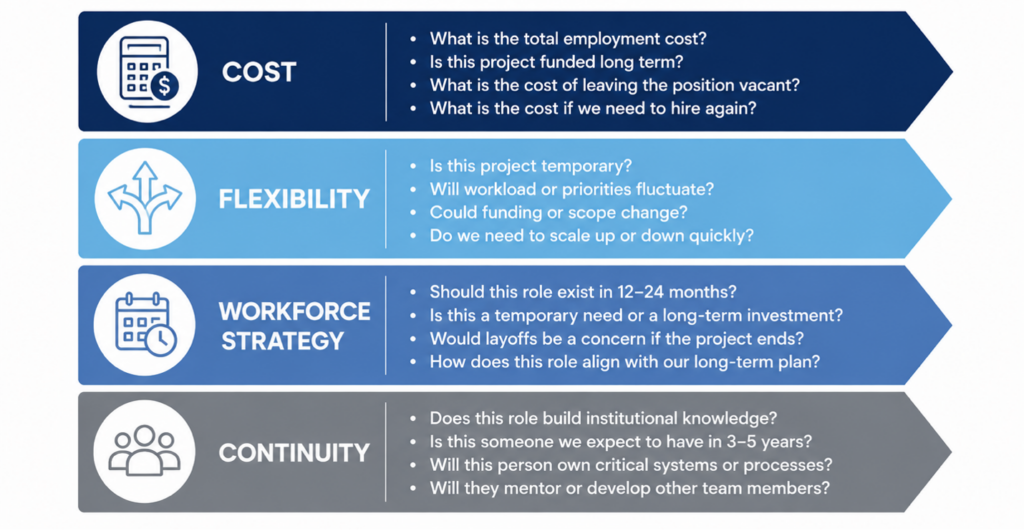
Cost
This is not just the headline number. The fully loaded cost of each model, including benefits, payroll burden, recruiting, onboarding, and what it costs you if the decision doesn’t work out.
Flexibility
How much room do you need to scale up, scale down, or change direction without being locked into a long-term commitment? Project-based work with a defined end date calls for a different level of flexibility than an ongoing operational role. On multi-year capital projects, this cuts the other way too: staying on contract longer can be the flexible choice, since headcount need past the current project phase often isn’t confirmable yet.
Workforce Strategy
Is this role about filling a capacity gap, testing a new capability, or building something the organization will lean on for years? The answer shapes which model makes sense.
Continuity
How much does this role depend on institutional knowledge, long-term relationships, or deep familiarity with your systems and processes? The more continuity matters, the more that points toward direct hire.
No single pillar decides the outcome on its own. A role can need a lot of flexibility but not much continuity, and that combination points somewhere specific. Run every open requisition through all four, and the right model gets a lot less subjective.
Understanding the Total Cost
Comparing an hourly bill rate to an annual salary is an apples-to-oranges comparison. A $110/hour contract employee bill rate and a $140,000 direct hire cost look pretty different on the surface, but that surface comparison doesn’t tell the whole story.
The Real Cost Comparison
| Cost Component | Contract | Contract-to-Hire | Direct Hire |
|---|---|---|---|
| Compensation | $110/hr | $110/hr. during evaluation | $140,000 salary |
| Benefits & Payroll | Included in bill rate | Included until conversion | ~$35,000 to $45,000 |
| Recruiting | Included in bill rate | Included in bill rate during evaluation | Internal recruiting costs or placement fee (up to 25%) |
| HR Admin. | Minimal | Minimal until conversion | Full employer responsibility (~3%) |
| Annualized Total | $228,800 | $228,800 | Up to $224,200 |
The bill rate on a contract placement already includes what a direct hire requires you to fund separately: benefits, payroll administration, recruiting overhead, and HR support. Once you strip those costs out and look at the fully loaded number, the gap narrows quite a bit.
This doesn’t mean contract is always more expensive or that direct hire is always cheaper. It means salary alone isn’t the number to anchor a decision on. The fully loaded cost, not the sticker price, is what belongs in the comparison. And even then, it’s only part of the decision framework for what type of hire makes sense.
The Hidden Cost of the Wrong Hire
SHRM estimates replacing a full-time employee costs 50% to 200% of their annual salary, taking into account severance, sunk recruiting, and a slow rehire cycle. That’s a $70k – $280k cost when considering the $140k role from above. Contract staffing avoids this exposure entirely while contract-to-hire defers it until you’ve confirmed fit.
And financials only tell part of the story. A wrong hire doesn’t just cost money to unwind. It costs momentum, and it costs people.
Think about what actually happens on the ground. The team absorbs the gap while the role sits vacant, which usually means overtime, missed personal time, and burnout creeping in on people who were already stretched thin. If the role ends up getting eliminated after a project wraps, instead of being planned as project-scoped from the start, that’s a layoff nobody wanted to make, and it lands hard on morale well beyond the person who was let go. Teams notice when hiring decisions don’t hold up, and it makes the next hiring announcement a little harder.
Applying the Framework: When Each Hiring Model Makes Sense
| Framework Pillar | Contract Staffing | Contract-to-Hire | Direct Hire |
|---|---|---|---|
| Cost | Total cost sits in the bill rate, with no separate payroll or benefits spend. If funding ends or the project wraps early, there’s no vacancy cost and no cost to hire again, the engagement just ends. | Same fully loaded cost as contract during the evaluation window. If it converts, direct-hire costs kick in, but you’ve de-risked the decision to hire again before you’re locked in. | Total employment costs include salary, benefits, payroll burden, and any recruiting fees. That only pays off if the role stays funded long enough to justify it. If it doesn’t work out, you’re covering the cost of the vacancy and the cost of hiring again. |
| Flexibility | Highest. Built for exactly this: workload fluctuates, funding could shift, or scope could change, and you can scale up or down without renegotiating an employment relationship. | Moderate. Gives you room to see whether workload, scope, and funding hold steady before locking in. | Lowest. Best when the role isn’t going anywhere regardless of near-term shifts in workload or funding. |
| Workforce Strategy | Fits when the role has a foreseeable or finite end date or when funding is tied to a specific project rather than a long-term plan. | Fits when you’re not sure yet whether this is a temporary need or a long-term investment, or when you anticipate a long-term need and want on-the-job evaluation before committing. | Fits when the role is clearly part of the long-term plan and layoffs aren’t a concern if any one project wraps. |
| Continuity | Lowest. Not built to own critical systems long-term or develop other team members. | Builds toward continuity only after conversion. Institutional knowledge starts accumulating, but it isn’t guaranteed. | Highest. Built for someone who’ll still be here in 3 to 5 years, can own critical systems or processes, and can mentor others. |
| Project Type Examples: | Best for projects with a defined start and finish, such as:
|
Best for projects that need support now and an evaluation for ongoing need, such as:
|
Best for ongoing / operational projects and responsibilities, such as:
|
Every column wins somewhere, and that’s the point. Knowing when to use contract staffing starts here: it isn’t a fallback for when you can’t justify a full-time hire. It’s the right call when the work itself is finite, and it’s the staffing model that tends to serve engineering and energy teams best given how project-driven this industry is. Most of the work in this space has a start and an end date, which is exactly where contract staffing shines: you get the expertise you need, exactly when you need it, without carrying the cost or commitment before or after the project wraps. And because many of these engagements now run alongside multi-year capital programs, contract staffing increasingly means a long-term, stable engagement, not a short stint, just without a permanent commitment on your books.
Contract-to-hire earns its place when you’re not yet sure whether the need is temporary or permanent or you want to see a hire in on the job, doing the work, before making a commitment. And direct hire earns its place specifically when continuity and institutional knowledge are integral to the role and you see this role having a place on the team long-term.
The contract-to-hire vs. direct hire question, like the rest of this framework, isn’t which model is best across the board. It’s which model fits a particular role, right now.
Compliance Considerations
Compliance is part of the cost equation too: each hiring model comes with its own compliance responsibilities, and getting the classification wrong doesn’t just create exposure, it creates financial and legal risk.
Contract staffing keeps employment obligations like payroll taxes, workers’ comp, and benefits administration including unemployment claims, WARN Act notice requirements for larger layoffs, and wrongful termination exposure for as long as the person is employed with the staffing firm, which acts as employer of record (not the client). Contract-to-hire keeps that same arrangement in place through the evaluation window, so the client isn’t taking on full employer liability before they’ve committed. Direct hire shifts all of that responsibility to the hiring organization, permanently, from day one.
Getting this wrong, whether that’s a worker classification error or blurring the line between contract and employee status, creates legal and financial risk. When in doubt, treat the compliance question with the same care you’d give the cost question.
Choosing the Right Model for Your Business
Don’t standardize on one hiring model. Standardize on a decision-making framework.
Every open role should be run through the same four questions:
- Cost: What’s the fully loaded cost of each option, not just the headline number?
- Flexibility: How much room does this role need to scale or change direction?
- Workforce Strategy: Is this about filling capacity, testing a new capability, or building long-term organizational strength?
- Continuity: How much does this role depend on institutional knowledge and long-term relationships?
The strongest engineering organizations don’t ask whether contract staffing, contract-to-hire, or direct hire is the best option. They ask which model best supports the role, the project, and the long-term needs of the business.
How AEG Helps Engineering Leaders Choose and Execute the Right Hiring Model
The contract vs. direct hire decision doesn’t just come down to cost. It’s also dependent on the flexibility, workforce strategy, and continuity. Getting the right answer takes a partner who knows your engineering environment well enough to recommend the right model for each specific role, not just fill the requisition in front of them.
AEG specializes in energy and utilities staffing, and engagement model selection is part of the job, not an afterthought. We look at your project pipeline and workforce mix, then help you decide whether contract, contract-to-hire, or direct hire fits the role in front of you. Our nuclear engineering recruitment work is proof we can execute in clearance-dependent, high-stakes environments where getting the model wrong isn’t an option.
Not sure which model fits your next hire? Contact us to talk through your project timeline and workforce plan.
Frequently Asked Questions
What conversion fee should I expect when converting a contract engineer to a direct hire?
Conversion fee agreements vary by staffing firm and are typically negotiated as part of the original contract-to-hire agreement. They can range from no fee at all, to up to 25%. It’s important to ask about this structure up front, before the engagement begins, not after you’ve decided you want to keep someone.
How long should a contract-to-hire evaluation period last before converting an engineer?
For most engineering roles, 180 days is the absolute minimum, while 1 year is more realistic for roles involving complex project ramp-up or security clearances. A shorter period risks converting before you’ve seen the engineer handle a real challenge; a longer period risks losing them to a competing permanent offer.
What happens to an engineer’s benefits and PTO when they convert from contract to direct hire?
This depends on the staffing firm. Benefits earned under a staffing firm’s plan generally don’t carry over automatically, since the engineer moves onto a different plan with its own eligibility rules. Ask your staffing partner how they handle this.
Do contract engineers have lower retention rates than direct hires in regulated industries?
Not necessarily. Converted contract-to-hire engineers often show equal or better retention because the hiring decision was based on proven performance. For pure contract roles on finite projects, retention isn’t the right metric; project completion rate and backfill frequency are more meaningful indicators of success.
Can I use both contract and direct hire models simultaneously for the same engineering team?
Yes. A blended workforce model is a common and effective strategy. The key is to clearly define which roles are core to your long-term operations (direct hire) and which are needed for surge capacity or specific projects (contract). Consistent onboarding, safety protocols, and team integration are crucial to making this model work.