
How Do Staffing Agencies Work? A Guide for Engineering & IT Hiring Managers
TL;DR
- The staffing process for technical roles is fundamentally different from generalist staffing; success hinges on your agency partner’s domain expertise, particularly during intake and vetting.
- An agency’s bill rate is not just the candidate’s pay plus profit. It’s a cost stack including mandatory payroll burden (22 to 32%), insurance, overhead, and the agency’s gross margin (18 to 35%).
- Contract, contract-to-hire, and direct hire are risk allocation strategies, not just fee structures. Choose the model based on your project timeline, budget, and confidence in the role’s definition.
- As the client, you share a co-employment relationship with the agency for contract workers, retaining liability for worksite safety and certain legal obligations.
- The quality of a placement is determined before you see a single resume. A deep, technical intake call is the single best predictor of a successful hire.
Your senior controls engineer just gave two weeks’ notice. You have a substation commissioning deadline in 90 days, and your internal talent acquisition team’s pipeline has zero candidates with experience in substation automation, relay controls, and NERC CIP-regulated environments. You’re considering a staffing agency for the first time, or you’ve only used one for administrative roles, never for a licensed or cleared technical position.
If you search online for an explanation of how staffing agencies work, you’ll find a generic process designed for light-industrial or administrative placements. That model breaks down when the cost of a wrong hire isn’t just lost productivity, but a missed project deadline or a compliance violation. The mechanics change meaningfully when a role requires domain-specific vetting, regulatory familiarity, or precise project-phase timing.
This is a hiring manager’s guide to the actual process. We’ll walk through how a specialized technical staffing partner operates, from the initial intake call to placement, with a focus on bill-rate economics, engagement model trade-offs, and the vetting depth that separates a true partner from a resume-forwarding service.
What Is a Staffing Agency and What Does It Actually Do for Employers?
A staffing agency is a firm that sources, screens, and supplies workers to client companies, serving as the employer of record for contract and temporary placements while the client directs the day-to-day work. For engineering and IT hiring managers, the critical distinction is not “staffing agency vs. temp agency,” but whether the firm operates as a generalist resume aggregator or a specialized partner with domain expertise in your technical discipline.
According to the American Staffing Association, staffing firms hire millions of temporary and contract employees each year, but a vast number of those placements are in administrative, industrial, or healthcare support roles. Technical placements in fields like engineering represent a smaller, higher-stakes segment.
A true staffing partner assumes significant administrative and legal burdens on your behalf. They offer multiple engagement models, typically contract, contract-to-hire, and direct hire placement, and the agency’s role, risk exposure, and fee structure differ across each. Ultimately, the agency’s value is not just in finding people, but in reducing your time-to-fill, mitigating hiring risk, and handling the employment liability for a flexible workforce.
How the Staffing Agency Process Works: Six Steps from Job Order to Placement
How a staffing agency works depends on the engagement model, but the core process follows six steps from the initial job order through placement. The quality of the outcome is largely determined by what happens in the first two.
Let’s use a running example: a mid-market utility company in the Midwest needs a protection and controls engineer with NERC CIP experience for a nine-month substation upgrade project. Here’s how a specialized agency would handle the job order.
Phase 1: Intake and Job Order Definition
Step 1: The Client Submits a Job Order. The process begins when you, the hiring manager, contact the agency with a need. This can be a formal requisition through a vendor management system (VMS) or a direct call to an account manager.
Step 2: The Agency Conducts a Detailed Intake Call. This is where most placements succeed or fail, and where generalist agencies reveal themselves. A strong intake for a technical role goes far beyond the job title and pay range. For our substation engineer, the intake call must capture:
- Required Licensure: Is a Professional Engineer (PE) license required? In which state?
- Regulatory Familiarity: Does the role require NERC CIP training or experience with specific utility standards?
- Technical Environment: What specific systems will they use? SEL or ABB relays? A particular SCADA platform?
- Project Scope: Is this a greenfield project or a brownfield upgrade? Will they work on an energized site?
A generalist recruiter won’t know to ask these questions. They’ll take the job description and send it to their database, leading to a high submittal volume but a low submittal-to-interview ratio. A specialized partner’s detailed job order intake ensures they are searching for the right fit from the start.
Phase 2: Sourcing, Screening, and Submittal
Step 3: The Agency Sources and Identifies Candidates. Sourcing for specialized technical roles relies less on public job boards and more on the agency’s existing candidate network, referrals, and direct outreach to passive candidates. A controls engineer with 10 years of utility experience is almost never actively applying for jobs on Indeed. Specialized firms use Applicant Tracking Systems (ATS) like Bullhorn or Ceipal to manage their talent pipelines, but the real differentiator is their bench strength, a curated network of pre-vetted professionals with relevant project histories.
Step 4: Candidates Are Screened and Vetted. Before you see a single resume, the agency’s recruiters conduct multiple screening steps. This includes an initial screen to confirm interest and availability, followed by a deeper technical conversation to validate their experience against the job order. (We’ll cover technical vetting in more detail later.) For our engineer, this means confirming they have hands-on experience with relay settings, not just adjacent project management experience.
A quality submittal package includes not just a resume, but a recruiter’s summary that maps the candidate’s skills directly to your requirements, flags any potential gaps, and confirms their rate and availability.
Phase 3: Interview, Placement, and Ongoing Support
Step 5: The Client Interviews and Selects a Candidate. The agency coordinates interviews between you and the shortlisted candidates. Once you make a selection, the agency extends the offer and manages any negotiations.
Step 6: The Candidate Is Onboarded and Starts the Assignment. For contract placements, the agency handles all onboarding paperwork, background checks, drug screens, and payroll setup. They are the employer of record. You manage the day-to-day work, providing technical direction and project oversight. But the work isn’t over for the agency. Strong partners don’t disappear after the first day; they manage the entire assignment lifecycle, checking in with both you and the contractor during the first 30 – 60 days and beyond to identify and resolve any fit issues early. This proactive support is critical for reducing the risk of fall-off and ensuring project continuity.
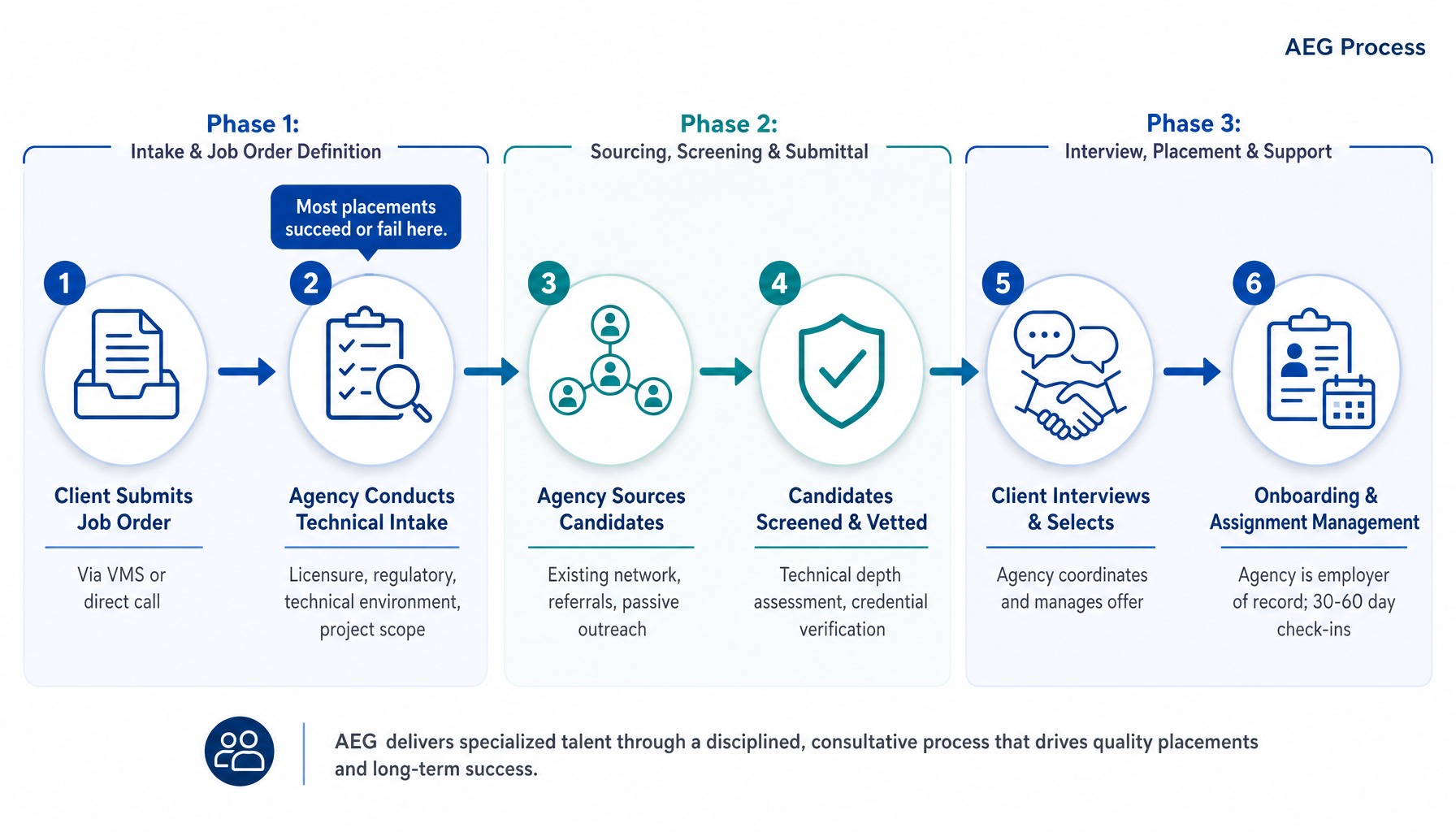 How does a staffing agency work? Six steps across three phases.
What You’re Actually Paying For: Bill Rate Economics Explained
A staffing agency’s bill rate is not the candidate’s pay rate plus profit. It is the candidate’s pay rate plus a mandatory cost stack that includes payroll taxes, workers’ compensation insurance, unemployment insurance, benefits, and administrative overhead, with the agency’s gross margin layered on top.
Let’s walk through a concrete example. Say you agree to a pay rate of $55/hour for a contract electrical engineer. Here’s how the bill rate is constructed:
- Pay Rate: $55.00/hour (What the employee receives before taxes)
- Statutory Burden / Burden Rate Loading: This includes payroll taxes (FICA), federal and state unemployment insurance (FUTA/SUTA), and workers’ compensation. This typically adds 22% to 32% to the pay rate, depending on the state and role. For our engineer, let’s assume a 28% burden.
Burden Cost: $55.00 x 0.28 = $15.40/hour - Total Cost (Breakeven Rate): $55.00 + $15.40 = $70.40/hour. This is roughly what it costs the agency to employ the engineer before any profit.
- Agency Gross Margin (Spread): On top of the total cost, the agency adds its margin, which covers its recruiters’ salaries, overhead, and profit. For technical staffing, this typically ranges from 18% to 35% of the final bill rate.
If the agency targets a 22% gross margin, the final bill rate would be approximately $82/hour. ($70.40 represents 78% of the final bill rate, so $70.40 / 0.78 = ~$90.25. Let’s adjust the example for a more typical markup. A 1.5x markup on pay rate is common, leading to a bill rate of $82.50. In this case, the spread is $27.50, and the gross margin is $12.10/hr after burden, which is a more realistic 14.6% margin on the bill rate.)
Let’s re-calculate with a standard markup model for clarity. A common industry practice is to apply a markup multiplier to the pay rate. If the markup is 1.50:
- $55.00 (Pay Rate) x 1.50 (Markup) = $82.50/hour Bill Rate.
- The difference ($27.50) is the “spread.” From this, the agency pays the ~$15.40 in burden costs, leaving a gross margin of $12.10/hour.
Workers’ comp class codes matter immensely. A field engineer on an energized utility site carries a far higher insurance premium than a remote software developer at the same pay rate. Understanding this cost stack makes you a better buyer. Instead of just pressuring an agency on the bill rate, which often just squeezes the candidate’s pay, you can have a more strategic conversation about margin and volume commitments.
Contract, Contract-to-Hire, and Direct Hire: Choosing the Right Engagement Model
Contract, contract-to-hire, and direct hire are not just fee structures but risk allocation decisions that should align with your project timeline, budget authority, and confidence in the role definition.
| Dimension | Contract Staffing | Contract-to-Hire | Direct Hire |
|---|---|---|---|
| Cost | Total cost sits in the bill rate, with no separate payroll or benefits spend. If funding ends or the project wraps early, there’s no vacancy cost and no cost to hire again, the engagement just ends. | Same fully loaded cost as contract during the evaluation window. If it converts, direct-hire costs kick in, but you’ve de-risked the decision to hire again before you’re locked in. | Total employment costs include salary, benefits, payroll burden, and any recruiting fees. That only pays off if the role stays funded long enough to justify it. If it doesn’t work out, you’re covering the cost of the vacancy and the cost of hiring again. |
| Flexibility | Highest. Built for exactly this: workload fluctuates, funding could shift, or scope could change, and you can scale up or down without renegotiating an employment relationship. | Moderate. Gives you room to see whether workload, scope, and funding hold steady before locking in. | Lowest. Best when the role isn’t going anywhere regardless of near-term shifts in workload or funding. |
| Workforce Strategy | Fits when the role has a foreseeable or finite end date or when funding is tied to a specific project rather than a long-term plan. | Fits when you’re not sure yet whether this is a temporary need or a long-term investment, or when you anticipate a long-term need and want on-the-job evaluation before committing. | Fits when the role is clearly part of the long-term plan and layoffs aren’t a concern if any one project wraps. |
| Continuity | Lowest. Not built to own critical systems long-term or develop other team members. | Builds toward continuity only after conversion. Institutional knowledge starts accumulating, but it isn’t guaranteed. | Highest. Built for someone who’ll still be here in 3 to 5 years, can own critical systems or processes, and can mentor others. |
| Project Type Examples: | Best for projects with a defined start and finish, such as:
|
Best for projects that need support now and an evaluation for ongoing need, such as:
|
Best for ongoing / operational projects and responsibilities, such as:
|
Engagement models are risk allocation strategies; choose based on your situation.
Here’s a simple heuristic:
- If your project scope is defined and time-bound, start with a contract.
- If the role is permanent but you want an on-the-job evaluation period, use contract-to-hire.
- If the role is critical leadership or requires deep integration from day one, go direct hire.
Read more: Why Contract-to-Hire Makes Sense in Technical Hiring
What Technical Vetting Actually Looks Like for Engineering and IT Roles
Staffing agencies vet candidates through background checks, reference checks, and skills assessments. For engineering and IT roles, the screening process must go deeper to verify credentials that directly affect project compliance and safety.
If your agency’s vetting process for a licensed engineer is the same as its process for an administrative assistant, you have the wrong agency. Proper technical vetting includes:
- Licensure Verification: Confirming active Professional Engineer (PE) or Fundamentals of Engineering (FE) status, checking for disciplinary actions through state boards, and verifying the license covers the relevant discipline and jurisdiction.
- Clearance and Compliance: For roles in energy, defense, or critical infrastructure, this means confirming active security clearance levels, verifying NERC CIP training completion, or ensuring ITAR compliance status.
- Technical Depth Assessment: This isn’t a generic skills test. It’s a conversation, often with a domain-savvy recruiter, that probes project-specific experience. Has the candidate actually designed relay protection schemes, or did they just work adjacent to someone who did?
Shallow vetting is a huge risk. An agency might submit a candidate whose resume lists “protection and controls engineering,” but targeted assessments could reveal their role was primarily documentation support, not design, a critical failure you might only discover after they’ve struggled for weeks on your project.
Co-Employment and Employer of Record: What Hiring Managers Need to Understand About Liability
In a contract staffing arrangement, the staffing agency is the employer of record. It handles payroll, employment taxes, workers’ compensation, and benefits administration. However, the client company retains day-to-day work direction, which creates a co-employment relationship with shared legal obligations.
This means you are not fully insulated from liability. OSHA workplace safety obligations, for instance, apply to the worksite employer regardless of who signs the paycheck. Discrimination or harassment claims can name both the agency and the client. For engineering roles on active construction sites, utility substations, or manufacturing floors, this is a material risk.
You might assume the agency “handles all that.” That assumption can be costly.
A well-structured staffing agreement should clearly delineate responsibilities: who provides PPE, who conducts safety orientation, and who manages incident reporting. Before signing any agreement, review these terms with your legal and risk teams. Do not treat it as a simple procurement document.
Read more: 5 Benefits of Hiring Contract Employees in Tech
(This information is for educational purposes and is not legal advice. Please consult your legal counsel for guidance on your specific situation.)
How AEG Approaches IT and Engineering Staffing Differently
The challenge for hiring managers is finding an agency that operates with the technical depth this article describes. AEG, an engineering-focused staffing firm in St. Louis, was built specifically for this purpose.
Our recruiters conduct detailed technical intake because they understand the disciplines they serve. They know the difference between a controls engineer who designs relay schemes and one who documents them. We don’t just match keywords; we align a candidate’s project history with your technical environment and business objectives. Through flexible engagement models like contract staffing, contract-to-hire, and direct hire placement, we provide pre-vetted professionals sourced from deep networks within the energy, utility, and industrial sectors. We recognize that for our clients, a placement isn’t a transaction; it’s a critical component of project delivery.
If you have an engineering or IT role that’s been open too long or requires specialized credentials, a conversation with AEG’s team will clarify whether we’re the right fit.
Talk to AEG about your open engineering or IT role
Your Staffing Agency Is a Partner, Not a Vendor
Understanding how staffing agencies work isn’t about memorizing a six-step process. It’s about knowing which questions to ask to determine if a potential partner has the domain depth to fill your role correctly the first time. The generic model you see online is a skeleton; it only becomes useful when filled in with the specifics of your technical world: clearance requirements, licensure verification, and co-employment liability.
The hiring managers who get the best outcomes from staffing agencies are those who see the relationship as a strategic technical partnership, not a commodity vendor transaction. They invest time in the intake process, provide transparent feedback, and collaborate to build a pipeline of talent. Ultimately, they choose a partner who understands that the real goal isn’t just to fill a seat, but to ensure a project succeeds.
Frequently Asked Questions
Who pays the staffing agency, the employer or the worker?
The employer pays the staffing agency in all legitimate arrangements. For contract placements, the employer pays an hourly bill rate. For direct hire placements, the employer pays a one-time fee, typically 15 to 25% of the candidate’s first-year salary. An agency that charges candidates is a major red flag.
How long does it typically take a staffing agency to fill an engineering or IT position?
For contract roles where an agency has bench strength, you can see candidates in 48 to 72 hours and have someone start within 1 to 2 weeks. Direct hire searches for specialized engineers can take 4 to 8 weeks, depending on credential requirements and local candidate supply, as the qualified pool is often small and passive.
What happens if a staffing agency places a candidate who doesn’t work out?
Most agencies provide a guarantee. For contract roles, they will typically replace the worker at no extra fee. For direct hire, a 60 to 90 day guarantee is common, offering a replacement search if the candidate leaves or is terminated. Clarify these terms before signing the agreement.
Can we hire a contract worker permanently without paying a conversion fee?
This depends on the staffing agency and agreement. Some agencies require no fee, while some contract-to-hire models apply a portion of hours billed as a credit toward this fee.
Does the staffing agency handle workers’ compensation and benefits for contract employees?
Yes, as the employer of record, the agency manages workers’ comp, payroll taxes, and any benefits offered. However, your company retains OSHA obligations for worksite safety. For engineers on active job sites, you must still provide a safe environment, PPE, and site-specific safety orientation.